


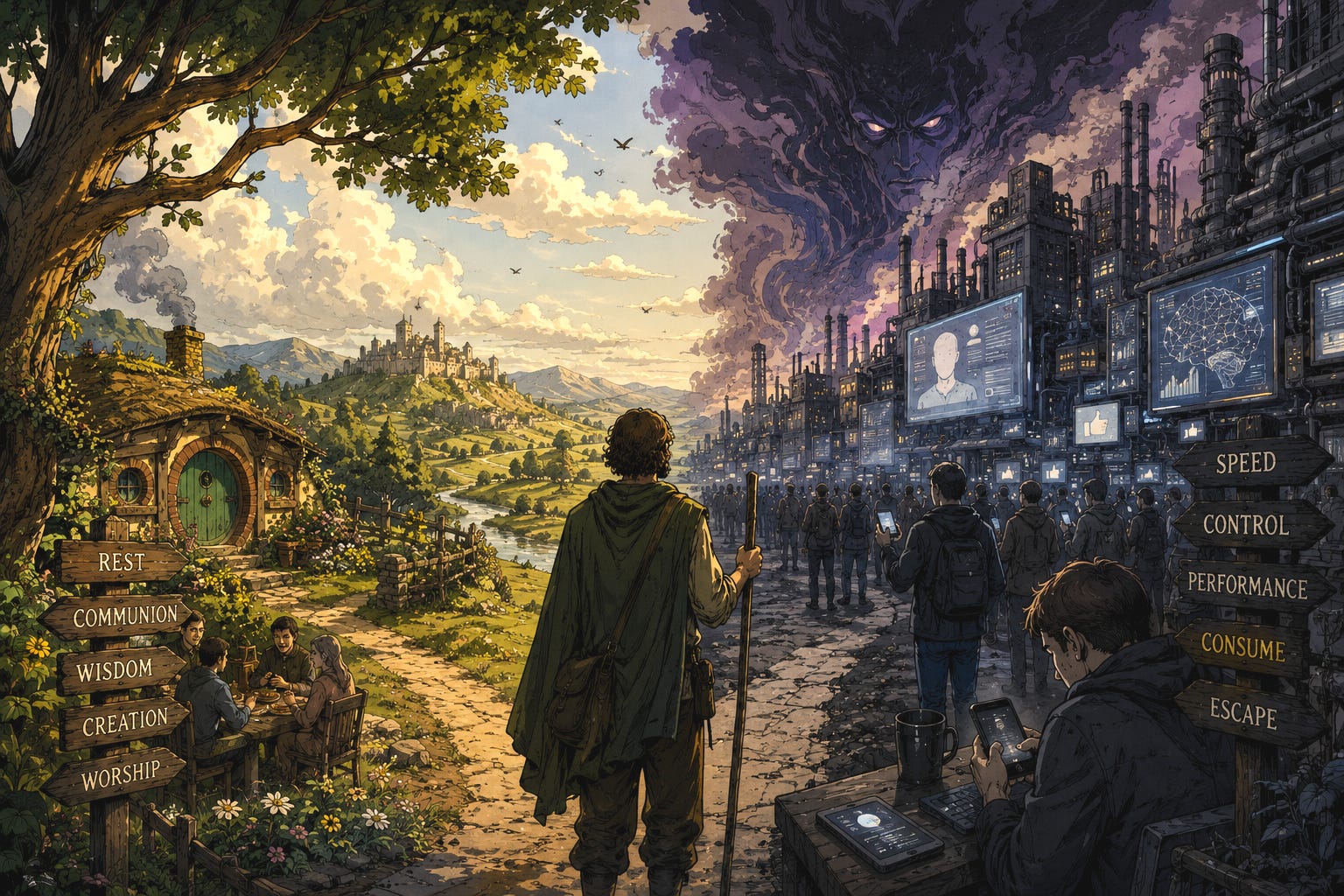
The Age of the Machine
If Tolkien were alive today, I imagine he’d shake his head at the world we’ve built and maybe even sigh a little. Few voices have seen modern life as clearly as his. Behind the Elves, Hobbits, and walking trees was more than fantasy; it was a moral vision. Tolkien was warning us about what happens when human will reaches for control instead of communion.
When he spoke of the Machine, he wasn’t thinking about cogs and gears. He meant something deeper: that restless urge in us to make the world bend faster to our desires. It’s the craving for power that, as he once wrote, “makes the will more quickly effective.” It’s the instinct to dominate creation rather than delight in it, to manipulate what was meant to be received as a gift.
Nearly seventy years after The Lord of the Rings, his fears have taken digital form. The furnaces of Isengard have become server farms and data centers. The Machine hums quietly in our pockets, in algorithms, automation, and artificial intelligence. It promises knowledge without wisdom, speed without rest, and progress without purpose. Humanity’s reach has never been longer, yet our roots have rarely felt shallower.
When optimization becomes our liturgy, incarnation starts to feel unnecessary.
The Speed of Life
We rarely notice it, but the world has picked up an almost unbearable pace. Everything hums and buzzes all the time. News breaks before it’s even verified. Emails multiply while we sleep. Our devices promise connection, but most of the time they keep us performing—always producing, never pausing. It’s as if slowing down has become a kind of sin.
Sociologists call it acceleration. Tolkien would have called it the work of the Machine. Because speed, left unchecked, has a way of hollowing the soul. It leaves us efficient but empty, connected but lonely. The algorithms that shape our days reward reaction more than reflection. We trade presence for performance and mistake motion for meaning.
Earlier this year, I decided to test that pace in my own life. I downgraded my iPhone to an old-fashioned “dumb phone.” No apps. No notifications. No endless scroll. Just calls and texts. At first, it felt like stepping off a moving walkway while everyone else kept rushing past. But then something started to shift. The silence that felt awkward at first began to sound a lot like peace. I looked up more. I noticed small things again—trees, faces, pauses in conversation. I started to feel present in moments that used to blur by. What had felt like loss began to feel like life.
Tolkien’s Shire was a protest against that kind of hurry. It offered a vision of life that moved at the speed of roots and rivers. Hobbits didn’t need the world to spin faster; they needed time for a second breakfast and a quiet walk home. Their way of life wasn’t laziness. It was sanity. They cared for what was near, tended what was living, and left enough margin to sing about it.
Maybe that’s part of our invitation too—to slow the tempo back down to something more human and more holy. Because hurry is a poor substitute for hope.
Artificial Intelligence and the Loss of the Human
Enter artificial intelligence—the latest and loudest promise of progress. It can think faster, write cleaner, and process more than we ever could. And yet, for all its brilliance, something in us still hesitates. Deep down, we know that what makes us human isn’t efficiency or information. It’s soul.
AI is the newest face of Tolkien’s Machine—that quiet hunger to make the will “more quickly effective.” It’s power wrapped in convenience, productivity disguised as progress. And like the One Ring, it whispers the same old temptation: you could do more, know more, control more—if only you’d wear me for a while. But every time someone does, something of their humanity slips away.
What we create has a way of re-creating us. The tools meant to serve us start shaping what we notice, how we think, even how we love. And in all our striving to build intelligence, we risk losing wisdom. Psalm 8 reminds us that our greatness isn’t self-made; it’s given. “You have made him a little lower than God and crowned him with glory and honor.” That’s the balance—dust and dignity, creature and crown.
Artificial intelligence can imitate thought, but not awe. It can echo our voices, but not our breath. It can generate words, but never worship. It can expand our reach, but it can’t teach us to love. And maybe that’s the question of our time: in our rush to build thinking machines, will we remember what it means to be living souls?
The Theology of Limits
From the very first pages of Scripture, God builds rhythm into creation—light and darkness, work and rest, sound and silence. Every living thing moves within a pattern of boundaries. And it’s no accident that the very first temptation in Eden was to step past one of those boundaries: “You will be like God.” That same lie still whispers through our age of endless innovation.
But limits aren’t curses. They’re the contours of blessing. The Sabbath, for example, is God’s gentle reminder that we are not machines. We are image-bearers, yes—but also dust-bearers. We need sleep, seasons, and silence. Rest isn’t a sign of weakness. It’s obedience. It’s our way of saying, “I am not the Creator; I’m His creature.”
Jesus lived within those holy limits. He didn’t rush. He walked. He withdrew to pray. He allowed Himself to hunger, to grow tired, to weep. The infinite Word chose to move at the pace of a human heartbeat. That truth alone should humble every dream of transcendence that forgets the gift of being finite.
A theology of limits is really a theology of love. Love always chooses to be bound for the sake of another. God’s power isn’t shown through constant expansion, but through incarnation—through being contained in flesh for our redemption. The cross, in that sense, is the ultimate limit, freely embraced.
So whenever a tool—digital or otherwise—promises boundless scale, the question for the Christian is simple: will this stretch me beyond love’s limits, or help me live within them?
That’s the lesson our modern world keeps forgetting. When we lose our sense of limits, we lose our sense of wonder. When everything becomes possible, nothing feels precious. Boundaries remind us what’s sacred. They’re not fences keeping us from joy; they’re the frame that gives joy its shape.
Reclaiming the Human Pace
If the theology of limits teaches us why we should slow down, the art of living slowly teaches us how. Tolkien gives us a glimpse of this in the rhythm of the Shire. It’s not that Hobbits rejected progress; they simply remembered what progress was for. Their days were filled with meals, stories, gardens, songs, and friendships. Their world moved at the speed of conversation, not computation. It was a simple life, but never a shallow one.
In our hurried age, recovering that kind of pace almost feels rebellious. The world tells us that worth is found in productivity and that attention is a kind of currency. We’re trained to believe that faster is always better, that the next app or update will finally streamline the soul. But the truth is, the soul doesn’t run on gigabytes. It grows best in silence, stillness, and slow attention.
Psalm 8 reminds us that before David ever lifted a sword or built a kingdom, he looked up. “When I consider your heavens…” he wrote. Awe came before action. Wonder shaped his work. That’s the rhythm of a faithful life—not speed, but sight.
Maybe that’s what God is calling us back to: the human pace. The quiet, steady rhythm of walking with Him in the cool of the day. For me, it began when I switched back to that old “dumb phone.” I wanted my attention to heal, to retrain my soul to listen again. It’s a small thing, but it helped me rediscover that peace doesn’t come through optimization—it comes through presence.
These kinds of practices aren’t nostalgic; they’re defiant in the best way. Every small, quiet choice becomes a way of pushing back against the Machine and saying, “I’m still human. I still have time for wonder.”
In the end, the goal isn’t to escape technology, but to keep it in its proper place—to remember that tools were made to serve the soul, not to swallow it.
Counsel for the Present Age
So how do we live faithfully in a world that never stops humming? How do we keep our hearts human when everything around us keeps speeding up, getting louder, and stretching our souls thin? Scripture doesn’t give us a formula, but it does show us a way—a slower, saner rhythm for a world running on fumes.
1. Recover Wonder
Before you scroll, look up. Before you speak, listen. David began with awe: “When I look at your heavens…” (Psalm 8:3). Wonder is the first act of worship and the first step toward wisdom. It pulls us out of anxiety and back into gratitude. Let your gaze direct the algorithms, not the other way around.
2. Honor the Body
We’re not minds floating through data—we’re dust and breath. Read from a real page. Take a walk. Share a meal. Touch the world God made. The incarnation wasn’t a metaphor; it was God’s declaration that matter matters.
3. Keep Sabbath Seriously
The digital age runs on constant access, but discipleship still runs on rest. Sabbath isn’t a quaint idea—it’s a command to stop producing and start receiving. Turn off the notifications. Let your attention breathe. For me, learning to rest became its own kind of rebellion against the idol of efficiency.
4. Cultivate Craft
As the new year approaches, find something to learn—something that takes time. Commit to a craft that resists the instant. Write by hand. Learn an instrument. Plant something and watch it grow. In a world of automation, craftsmanship retrains us in patience and care. It reminds us that good things take time and that creating is still an act of worship. Use AI as a tool, but never as a substitute for the slow work that shapes your soul.
5. Measure Progress by Love, Not Speed
Paul said it best: “If I have all knowledge but have not love, I am nothing” (1 Corinthians 13:2). Wisdom isn’t about how much we know, but how well we love. The fruit of the Spirit—love, joy, peace, patience—will never trend online, but they’ll last forever. If a technology multiplies output but drains patience, it’s probably working against your sanctification.
This is the kind of counsel Tolkien would have approved of—a return to the ordinary, to the rhythms of reality that move at the speed of grace. It isn’t anti-technology. It’s pro-humanity. It’s remembering that our worth is never found in how quickly we can make things happen, but in how faithfully we reflect the image of the One who made us.
The Majesty and the Machine
Psalm 8 begins and ends the same way:
“O LORD, our Lord, how majestic is Your name in all the earth.”
That’s no accident. The psalm opens with awe and closes with it, like bookends on a life rightly ordered. Between those two lines lies everything that makes us human—the wonder and the work, the limits and the love, the dust and the dignity. Maybe that’s the posture our generation most needs to recover.
Tolkien understood that the real danger of the Machine wasn’t technology itself, but what it does to the soul when we stop seeing the world as gift. When we try to master what was meant to be received, the enchantment fades, and we lose the music of creation. But when we live as sub-creators—humble stewards who make and mend in step with the Maker—the world becomes alive again with meaning.
Our task, then, isn’t to run from the digital or curse the modern world. It’s to live within it as people who remember who we are. We can use AI without bowing to it, hold our tools without letting them hold us. We are not algorithms; we are image-bearers. We are not producers; we are priests of creation. We were never meant to outpace God, but to walk with Him in the cool of the day. Perhaps holiness in this age will look less like speed and more like stillness. Less like mastery and more like mercy. Less like endless noise and more like quiet wonder.
Tolkien once said that all stories are echoes of a far greater Story. Maybe our calling, here in the midst of the Machine, is to make sure our lives echo the right one—the story where love wins, where limits are blessed, and where the name of the Lord remains majestic in all the earth.