


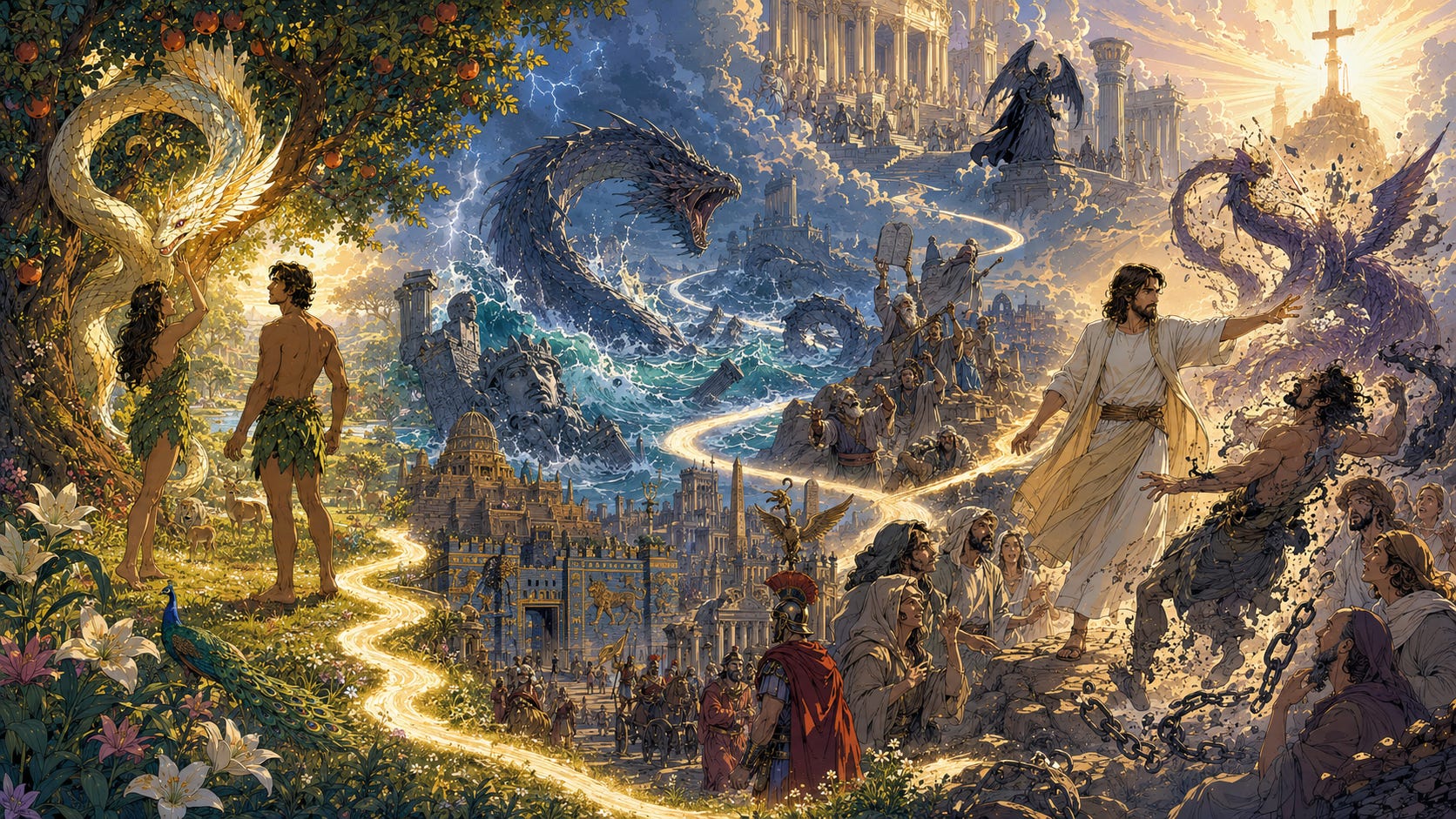
It’s been a little while since the last episode, so first, thank you for your patience and for continuing to follow along with the journey. Before we dive into the next phase of the Denizens of Darkness series and begin exploring Satan in Paul’s letters, I thought it would be helpful to pause for a moment and look back at where we’ve been and the ground we’ve covered so far.
As you know, we have been working through a long series called Denizens of Darkness—a biblical-theological study of Satan, demons, spiritual rebellion, and the powers of darkness.
Our goal has not been to sensationalize the supernatural or give the Enemy more attention than he deserves. Our goal has been to read Scripture carefully and trace how the Bible itself develops these themes across its canon. As we’ve seen, the Bible does not begin with a fully developed doctrine of Satan, demons, or the kingdom of darkness. Instead, the picture unfolds progressively, layer by layer, until the New Testament gives us greater clarity in the light of Christ.
We began where the biblical story itself begins: the garden.
In Genesis 3, Scripture introduces us to the serpent—the nachash. We spent time looking at why this figure should not be reduced to a mere talking animal, and why the language of Genesis 3 may point us toward something more strange, more supernatural, and more throne-room adjacent than many modern readers assume. The serpent appears in sacred space, speaks with deceptive wisdom, and leads humanity into rebellion against God.
From there, we explored the meaning of the serpent’s judgment. Being cast down to the dust is not simply an explanation for why snakes crawl. It is language of humiliation, demotion, and defeat. The serpent is brought low, and yet even there, in the middle of judgment, God gives the first promise of victory: the seed of the woman will crush the serpent’s head.
That promise becomes one of the major threads, if not THE major thread, running through Scripture.
After Genesis 3, we followed the serpent imagery through the Old Testament, especially through chaos-dragon language like Leviathan and Rahab. These passages show us how the biblical authors use ancient imagery of serpents, dragons, and sea monsters to proclaim something very different from the pagan nations around them. YHWH is not one god among many struggling to bring order out of chaos. He is the sovereign Creator and King who rebukes the sea, crushes the dragon, and will finally slay Leviathan.
Then we turned to the figure of ha satan in the Old Testament. Before “Satan” functions clearly as a personal name, the Hebrew phrase often means “the adversary” or “the accuser.” In Job and Zechariah, we find a courtroom-like figure who appears in the divine council and functions as an accuser or tester. That raised important questions about progressive revelation, translation, and how later Scripture fills in earlier categories.
We also spent time in the exile and Second Temple period, because that world forms the backdrop for the New Testament. Israel’s experience under foreign empires—Babylon, Persia, Greece, and Rome—forced serious theological reflection on evil, suffering, spiritual powers, idolatry, oppression, and the faithfulness of God. During this period, Jewish writings increasingly describe a chief adversary under names like Mastema, Belial, the Devil, the Angel of Darkness, and others. Those writings are not Scripture, but they do help us understand the world the New Testament writers were living in and responding to.
When we arrived in the Gospels, the picture became MUCH clearer.
Jesus does not treat Satan as a metaphor for evil or simply as a symbol of human wickedness. In the wilderness, Satan tempts Jesus directly. In the parables, Satan snatches away the word. In the Beelzebul controversy, Jesus speaks of binding the strong man. He warns Peter that Satan has demanded to sift him like wheat. He casts out demons, confronts unclean spirits, and announces the arrival of the kingdom of God as a direct assault on the kingdom of darkness.
In other words, the Gospels show us that the coming of Jesus is not merely moral instruction or religious reform: it is invasion! The King has come, and the powers of darkness know it (see the Transfiguration!)
From there, we looked at the General Epistles—James, Peter, John, Jude, Hebrews, and related texts. These letters do not give us a speculative demonology, but they do give the church sober, practical instruction. The devil prowls like a roaring lion. Believers must resist him, firm in the faith. The evil one is real, but those born of God are guarded by Christ. The Son of God appeared to destroy the works of the devil. Through death, Jesus broke the power of the one who held the power of death.
Again and again, the same pattern keeps emerging: Scripture is realistic about the Enemy, but never hopeless. The darkness is real, but it is not ultimate. Satan is active, but he is not sovereign. The powers are dangerous, but they are defeated powers.
The next few episodes will move into Satan in Paul’s letters.
That is an important next step, because Paul gives us some of the clearest teaching in the New Testament on spiritual warfare, false teaching, demonic powers, the “god of this age,” the “prince of the power of the air,” the armor of God, the schemes of the devil, and Christ’s victory over rulers and authorities. Paul helps us see that spiritual warfare is not only about dramatic encounters with demons. It also involves deception, accusation, idolatry, division, pride, false doctrine, bitterness, unforgiveness, and the slow corruption of the church’s faithfulness.
Eventually, this series will end in Revelation, where the whole biblical thread reaches its climax. There the serpent is finally and explicitly identified as “the dragon… that ancient serpent, who is called the devil and Satan.” The story that began in the garden ends with the Dragon exposed, defeated, judged, and cast down forever.
But we are not quite there yet.
For now, we are still tracing the story carefully, letting Scripture build the picture in its own order. And the more we trace it, the more obvious our main point becomes: the Bible’s teaching about Satan is never meant to distract us from Christ. It is meant to magnify Christ.
I appreciate your patience and am looking forward to seeing this series continue.
Thank you for joining me on this journey!